Biofilm and Persisters: The Molecular Cyst Hideout of Borrelia
“I swallowed heavy antibiotics for three weeks — and I am still fiercely sick.” I hear this defining sentence almost every single day as an infectiologist. It perfectly expresses the central, worldwide paradox regarding chronic Lyme disease: an accurate early diagnosis was made, the standard medical guideline therapy was strictly adhered to — and yet, the neural pain and profound exhaustion persist completely undiminished. To understand why standard medicine fails so radically here, we must venture deep into the evolutionary defense architecture of the bacterium itself: the impenetrable biofilm and the concept of "persister microbes".
The EPS Shield: What Exactly is a Biofilm?
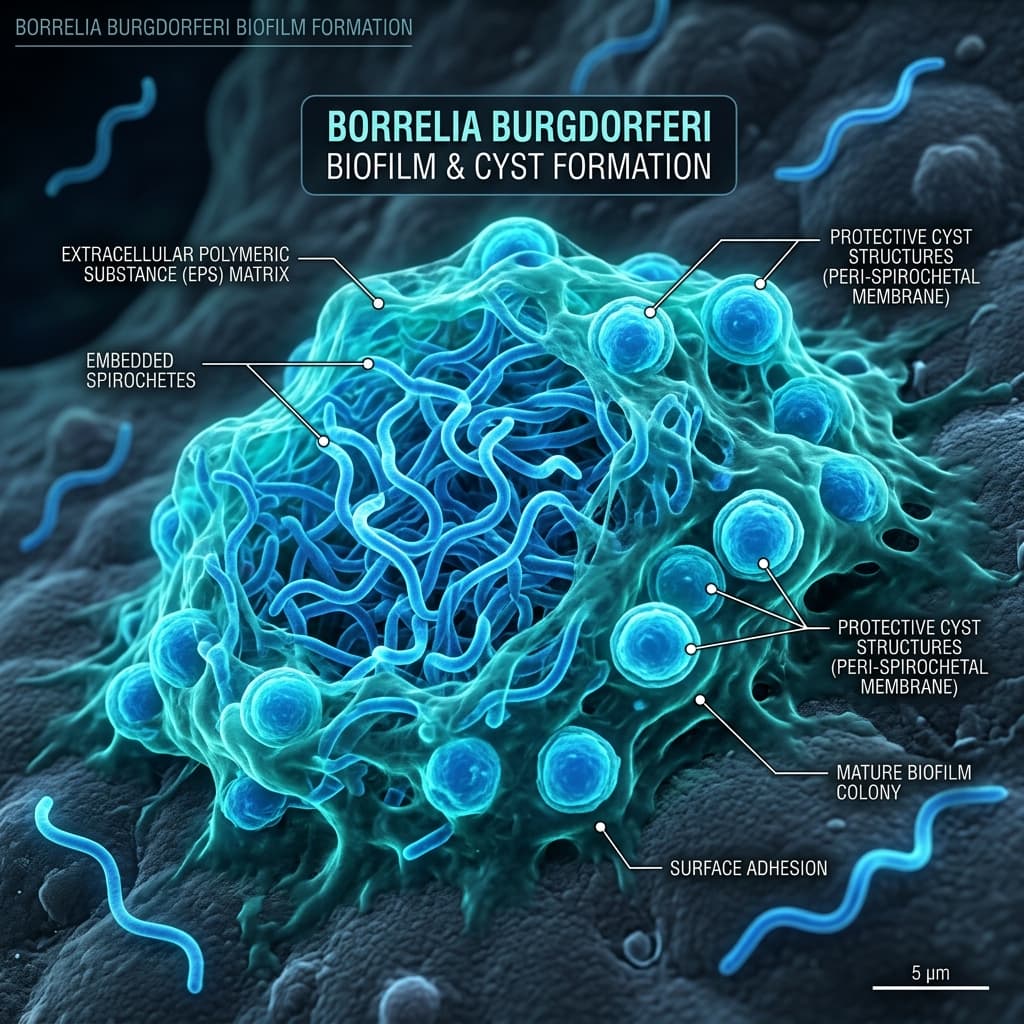
A biofilm is practically never a banal, random accumulation of bacteria. It is a highly complex, phenomenally organized "city" of microorganisms that collectively entrench themselves within a thick, self-produced mucus matrix composed of , calcium bridges, heavy metals, and bacterial DNA.
Borrelia (and their co-infections such as Bartonella) are highly capable of forging these indestructible biofilm architectures deep within human tissue — showing an absolute preference for the joint capsules, the central nervous system (specifically glial cells), and the dense endothelial layers of blood vessels. Safely protected behind this chemical shield, Borrelia regulate their activity using advanced cellular communication ().
The Antibiotic Bounce
Classic frontline antibiotics like doxycycline are physically unable to penetrate this sticky polysaccharide shell. Even worse: most beta-lactam antibiotics are designed to indiscriminately attack bacteria that are dividing rapidly. However, within the dense biofilm sanctuary, Borrelia intentionally slow their metabolic rate down to near zero. Consequently, conventional antibiotics strike into the biological void twice.
The Three Persistence Forms (Mutations)
Borrelia burgdorferi is considered an ultimate survival artist in microbiology. If the microbe senses systemic stress — triggered by our hostile immune system, sudden temperature shifts, or heavily dosed but poorly targeted antibiotic monotherapy — it chemically mutates into three fundamentally different survival configurations:
1. The Open Spirochete Form (Active Division)
The classic, corkscrew-shaped morphology that divides extremely rapidly. It is highly motile, swims openly in the bloodstream during early infection phases, and responds exceptionally well to standard antibiotics (doxycycline, amoxicillin). It is responsible for triggering early symptoms like erythema migrans (the bulls-eye rash) and fever.
2. The CWD L-Forms (Cell-Wall Loss)
Doxycycline and Penicillin attack the bacterial cell wall structures with high specificity. The Borrelia's intelligent evasion tactic: By quickly shedding the physical cell wall completely, these strong medications instantly become entirely useless. Disguised in this "naked" L-form, Borrelia persist deep intracellularly (such as within phagocytes or macrophages) without triggering any systemic alarms.
3. Dormant Persister Cysts (Round Bodies)
The most tragic error in modern Lyme care: Suboptimal, weak doses of antibiotics actually force millions of spirochetes to aggressively roll up into dense, spherical cysts. Buried deep inside their biofilm, they down-regulate their metabolism into a true cellular coma. They can survive heavily armed for decades as dormant time-bombs within the connective tissue. If the patient's immune barrier crashes (e.g., due to severe stress or cortisone usage), they simply unroll back into the acutely painful spirochetal form (a "relapse").
Modern Combination Therapy (Biofilm-Hacking)
Equipped with the stark reality of mucosal biofilms and persister cysts, it becomes crystal clear why a simplistic 3-week monotherapy is destined to fail. Leading global pioneers such as Dr. Richard Horowitz and the evidence-based studies emerging from Johns Hopkins University (Dr. Ying Zhang) now focus solely on multi-stage "Persister Protocols":
1. Biofilm Breakers (Phytotherapeutics & Enzymes)
Before any highly toxic antibiotics are applied, the slimy biofilm sanctuary must be actively dissolved. The systematic medical application of specific proteolytic enzymes such as Lumbrokinase, Nattokinase, or Serrapeptase directly "eats away" the rigid fibrin plaques of the bacterial castle. Simultaneously, herbal-based biofilm disruptors () actively deconstruct the vital calcium channels of the matrix.
2. Experimental Off-Label Research Approaches (Dapsone, Disulfiram)
In preliminary preclinical and clinical research, several prescription compounds are being investigated for potential activity against persistent forms, including dapsone (in experimental combination with rifampin) and disulfiram. Important medical notice: These represent purely experimental, off-label research approaches without approved indication for Lyme disease. Their use carries substantial health risks and severe adverse effects (including severe neurotoxicity, hepatotoxicity, and methemoglobinemia) and must never be attempted outside strictly controlled specialist medical supervision.
3. Pulsating Antibiotic Rhythms
Continuous antibiotic pressure may encourage persistent cysts to remain in a metabolically inactive state. In clinical research, pulsed therapy regimens with scheduled treatment intervals and rest periods are discussed, aiming to target bacteria when they transition back into active, susceptible forms.
Conclusion for Patients
"Chronic Lyme Disease Syndrome" is definitively not a psychological illness, nor is it a manufactured fiction. It is the absolute, evidence-based manifestation of extremely intelligent, networked biochemical defense mechanisms forged by the bacterium in the form of dormant cysts and highly resistant biofilm matrices. The incredibly naive mainstream medical paradigm that "2 weeks of doxycycline universally cures" utterly misunderstands the complexity of this microbe and dangerously provokes resistance. Those who successfully conquer chronic Lyme disease do not simply dose harder and blinder — they actively and surgically deconstruct the biofilm shield first.
— Dr. Philippe Bottero, Specialist for Infectious Diseases and Tropical Medicine
Scientific References & Evidence-Based Studies
- [1]
Sapi, E., et al. (2012): Characterization of biofilm formation by Borrelia burgdorferi in vitro. PLoS One
- [2]
Horowitz, R. I., & Freeman, P. R. (2019): Efficacy of Double-Dose Dapsone Combination Therapy in the Treatment of Chronic Lyme Disease/PTIDS. Antibiotics
- [3]
Liegner, K. B. (2019): Disulfiram in the Treatment of Lyme Disease and Babesiosis. Antibiotics